Hardware Hacking

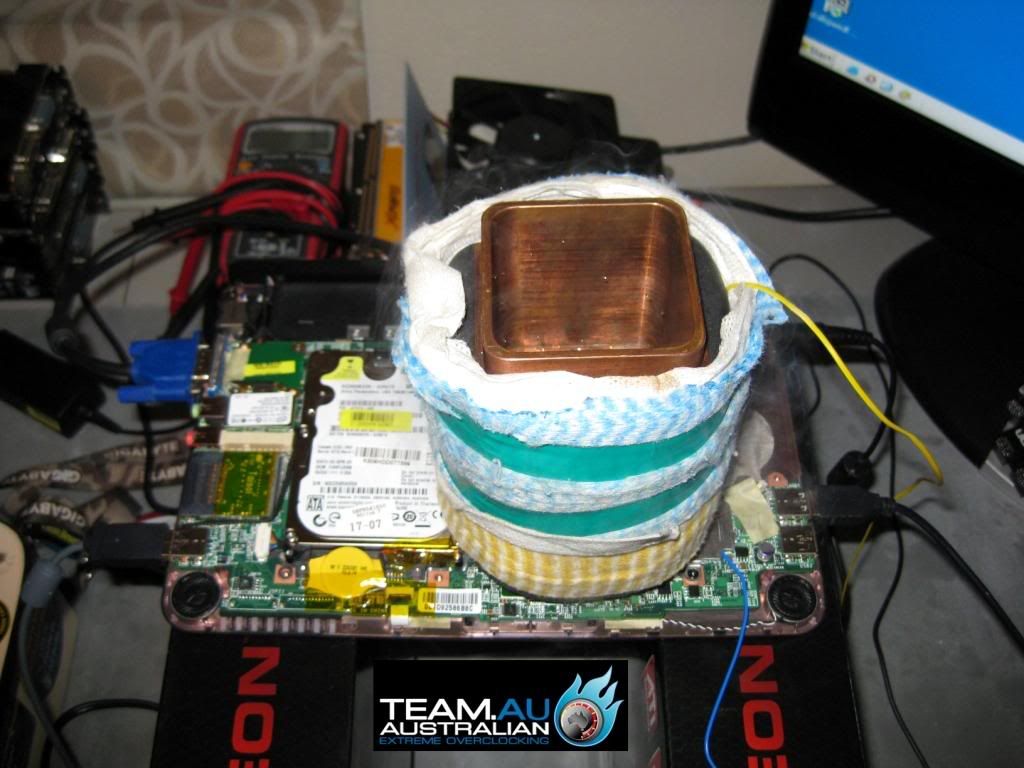
MSI Wind U100, Overclocked With Liquid Nitrogen 95

james writes "What do you get when you combine a MSI Wind U100 notebook with liquid nitrogen? The new Intel Atom frequency World Record ... and some damn cool pictures! A large copper pot is used, sitting on top of the GPU and chipset, and cold transfer through the original heatsink plate to the CPU. This was cooled down to about -20 C to achieve the new world mark. (Intel Atom N270 @ 2315mhz) For more information you can check out the original forum thread.
Hardware Hacking

History of the LED — the Movie 106

ptorrone writes "MAKE Magazine has a fantastic 'Connections'-style video called THE LED — The short documentary has the history of the LED to modern day applications. Starting with the work of Russian Oleg Vladimirovich Losev, which was largely ignored in the 1920s, to making your own 'Cat's Whisker' — a primitive LED made from a metal-semiconductor point-contact junction forming a Schottky barrier diode. The first practical visible-spectrum LED was developed in 1962 by Nick Holonyak Jr., while working at General Electric Company."
Hardware Hacking

Hacks Allowing Disabled Gamers To Play Guitar Hero 94

angrymilkman writes "Here are two interesting new approaches where researchers modified the popular Guitar Hero game so it can be played by gamers with disabilities. Air Guitar Hero modifies the Guitar Hero controller so someone without limbs can play it by using electrodes attached to the user's residual arm. Blind Hero is a mod for Frets on Fire that uses a haptic glove that can turn visual feedback into haptic feedback, allowing blind gamers to play Guitar Hero songs." There have been a variety of Guitar Hero hacks in the past, including a custom drum pad for playing the guitar part, using the plastic guitar as a real instrument, and rocking out with your bike, but it's nice to see some more serious modifications showing up.
Hardware Hacking

A Replica of the First 4004 Calculator 63

mcpublic writes "For the 37th anniversary of Intel's 4004, the world's first off-the-shelf, customer-programmable microprocessor, vintage computer enthusiast Bill Kotaska has successfully built a replica of Busicom's historic 141-PF printing calculator using vintage Intel chips. Decades before the ubiquitous 'Intel inside' sticker, Japanese calculator maker Busicom introduced the first product ever built around an Intel microprocessor. Bill's homebrew replica includes a rare Shinshu Seiki Model-102 drum printer and runs firmware extracted from the original Busicom ROMs. Schematics and photos of his re-creation are available at the unofficial 4004 web site, along with Tim McNerney's new PIC-based emulator of the Model-102 printer. The site includes the Busicom 'source code,' 4004 details, interactive simulators, and other goodies for students, engineers, and computer historians." We discussed the 36th 4004 anniversary project here last year.
Hardware Hacking

DNA Strands Modified Into Tiny Fiber-Optic Cables 113

holy_calamity writes "New Scientist reports on the latest idea from researchers trying to make microcomputers use photons in place of electrons — to make optical interconnects from strands of DNA. Mixing DNA strands with the right dye molecule upgrades them into wires for light, like microscopic optical fibers, able to absorb photons at one end and transmit them to the other. One of the neat things about using DNA is it is the right scale to play nicely with existing and future chip lithography. Quoting: 'The result is similar to natural photonic wires found inside organisms like algae, where they are used to transport photons to parts of a cell where their energy can be tapped. In these wires, chromophores are lined up in chains to channel photons.'"
Hardware Hacking

Physically-Challenged Gamer Hacks Together Custom PS3 Controller 50

Destructoid has a neat post about a gamer whose condition prevents him from using a standard video game controller. With the help of a company called GimpGear, which markets devices for people with limited mobility, he designed and built a custom input device that makes use of fingers, toes, and even sips or puffs of air to control his favorite games. Pictures and a video of the setup are both available in the post.
GNU is Not Unix

Creative GPLs X-Fi Sound Card Driver Code 369

An anonymous reader writes "In a move that's a win for the free software community, Creative Labs has decided to release their binary Linux driver for the Creative Sound Blaster X-Fi and X-Fi Titanium sound cards under the GPL license. This is coming after several failed attempts at delivering a working binary driver and years after these sound cards first hit the market."
Hardware Hacking

Inventor Open Sources "TV-B-Gone," and Why 340

ptorrone writes "Inventor Mitch Altman explains why he open-sourced his TV-B-Gone kit, the original stealth keychain fob for defeating TVs in public places. The title of the article is 'Patent-B-Gone' and perhaps the most interesting fact is that Mitch's brother is a patent attorney, but he still decided to release an open source hardware version of the TV-B-Gone, with pretty impressive results."
Hardware Hacking

D.I.Y. Home Security 377

theodp writes "The NYTimes reports that pre-wired home security installations by alarm companies are on the way out. Thanks to wireless window and door sensors and motion detectors, installing and maintaining one's own security system is becoming a do-it-yourself project, with kits available from companies like InGrid and LaserShield. Time to start cranking out some new iPhone and Android apps, kids?"
Data Storage

Silencing a Hard Drive Using Household Items 275

Reader Justblair recommends his blog entry detailing how he made a hard drive silencer for a pittance. "This article demonstrates a very easy-to-make hard drive silencer that not only outperforms most commercially available devices, but is cheaper to implement as well. Requiring very little in fabrication skills, it is an ideal addition to a media PC or HTPC. It may even suit you if your head is aching after many hours of being whined at by your hard drive."
Communications

Modern Methods For Sharing Innovation 91

The New York Times is running a story about Johnny Chung Lee, a hardware hacker made famous for his projects which modified the Nintendo Wiimote to do things like positional head tracking and multi-touch display control. The article focuses on the suggestion that Lee's use of YouTube to demonstrate his innovations has done a better job of communicating his ideas than more traditional methods could. Quoting: "He might have published a paper that only a few dozen specialists would have read. A talk at a conference would have brought a slightly larger audience. In either case, it would have taken months for his ideas to reach others. Small wonder, then, that he maintains that posting to YouTube has been an essential part of his success as an inventor. 'Sharing an idea the right way is just as important as doing the work itself,' he says. 'If you create something but nobody knows, it's as if it never happened.'"
Hardware Hacking

Open Source Hardware, For Fun and For Profit 122

ptorrone writes "Lots of open source hardware articles making the rounds this week, first up — Wired has an excellent piece on the Arduino project, an open source electronics prototyping platform, its founders and business model (they have sold over 50,000 units). And next up MIT's Tech Review has a profile on a few open source hardware businesses including NYC based Adafruit Industries best known for projects like the open source synth (x0x0b0x) and 'fun' projects like the Wave Bubble, the open source cell phone/wifi/GPS/RF jammer."
Hardware Hacking

An Inside-Out Look At the Antec Skeleton Case 64

Anonymous writes "Here's a step-by-step look at building a PC with the new Antec Skeleton PC chassis. It's obviously not for everybody, but at least Antec is trying out something relatively new for hard-core users. Not sure if you'd need an air spray can to keep the dust off all the components, though ..."
Hardware Hacking

Where to Find Axles, Gears For Kinetic Sculpture? 267

sneakyimp writes "My brother is an architect and sculptor and wants to create kinetic sculptures powered by wind, steam, and sun. He wants to avoid electrical systems and keep this mechanical. He's prepared to cast metals for custom parts if necessary, but is hoping to find a cheap source of gears, axles, and bearings for the internal mechanical workings of these contraptions. We'll need things like miter/bevel/spur/helical gears, standard and thrust bearings, and axles." Read on below for more on the details of what sneakyimp is looking for — dismembered Capsela units won't do it.
Hardware Hacking

X-Rays Emitted From Ordinary Scotch Tape 190

Maximum Prophet writes "When I was in High School, I built an X-Ray machine that (probably) didn't produce any X-Rays. I used an old vacuum tube and high voltage. Little did I know that simple triboluminescence would have enough energy to do useful work." The catch: you'll need to peel your tape in a vacuum, and have the x-ray film at the ready.
Data Storage

Build a Cheap Media-Reading PC? 255

tsm_sf writes "A recent Slashdot article got me thinking about dead and dying media. I'd like to build a cheap PC with the goal of being able to read as many old formats as possible. Size and power consumption would be design considerations; priority of media formats would be primary. How would you approach such a project?"
Hardware Hacking

Huge Credit Fraud Ring Sends Europeans' Data To Pakistan 166

marshotel excerpts from a story at the Wall Street Journal: "European law-enforcement officials uncovered a highly sophisticated credit-card fraud ring that funnels account data to Pakistan from hundreds of grocery-store card machines across Europe, according to U.S. intelligence officials and other people familiar with the case. Specialists say the theft technology is the most advanced they have seen, and a person close to British law enforcement said it has affected big retailers including a British unit of Wal-Mart Stores Inc. and Tesco Ltd."
Hardware Hacking

Overclocked Memory Breaks Core i7 CPUs 267

arcticstoat writes "Overclockers looking to bolster their new Nehalem CPUs with overclocked memory may be disappointed. Intel is telling motherboard manufacturers not to encourage people to push the voltage of their DIMMs beyond 1.65V, as anything higher could damage the CPU. This will come as a blow to owners of enthusiast memory, such as Corsair's 2.133MHz DDR3 Dominator RAM, which needs 2V to run at its full speed with 9-9-9-24 timings."

Slashdot Top Deals